Powder Coating Booths
When it comes to powder coating, having the right booth makes all the difference. Unlike liquid coatings, powder applications come with their own unique set of requirements—and that’s where we come in. Our powder coating booths are built tough with premium-grade G-90 galvanized steel, designed to handle whatever your finishing process throws at them while delivering consistent, quality results.
Powder coatings have been steadily taking over the finishing industry, growing into a preferred choice for manufacturers everywhere. Why? Powder coatings deliver durability and a beautiful finish without the added challenge of VOCs that come with liquid coatings. Additionally, with the right booth setup, you can actually reclaim and reuse your overspray, making your process more cost-efficient.
We know every operation is different, which is why we offer customization of your booth exactly how you need it. Contact our team today to explore your options and find the perfect powder coating spray booth for your application.
Choosing the Right Powder Coating Booth
Finding the perfect powder coating booth isn’t just about picking one from a catalog, it’s about understanding your specific needs and matching them with the right technology. Below is a breakdown of key decisions you need to make when choosing a powder coating booth.
Non-Recovery vs. Recovery Powder Booths
Non-Recovery
A non-recovery powder coating booth is outfitted with standard exhaust filters that are designed to collect powder overspray as you work. However, as their name implies, overspray powder cannot be reused once it’s collected by the filters. Additionally, these filters must be periodically replaced as they collect more powder to maintain an even airflow.
Non-recovery powder coating booths are typically chosen for their lower initial cost, and are a great choice for manufacturers who routinely change colors and powder types. However, for manufacturers that have a high-volume of work, not being able to recover powder coating can result in increased operational costs.
Recovery
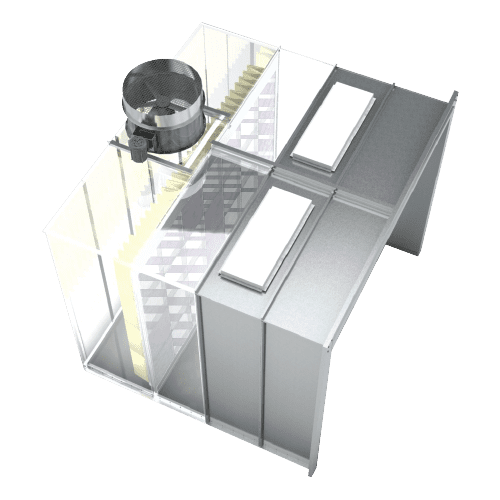
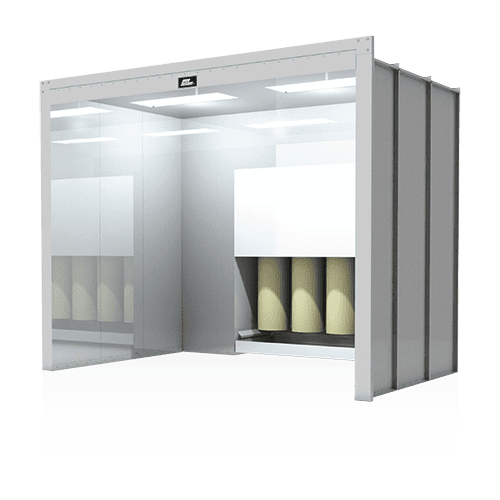
Compared to a non-recovery powder coating booth, a recovery powder coating booth is engineered to easily collect powder overspray while in use. Our recovery booths are designed with a cartridge-style filtration system that efficiently captures powder coating overspray, allowing clean air to recirculate back into your plant. This has the added benefit of eliminating the need for an exhaust stack, which often requires expensive air replacement systems.
While recovery booths present a higher initial cost compared to non-recovery models, they are an ideal powder coating booth for heavy-production powder usage. The added savings on powder coating recollection far outweigh the initial cost difference, often making recovery powder coating booths the cheaper long-term option.
Batch vs. Automated
How your booth fits into your workflow matters just as much as what type you choose.
Batch booths are typically freestanding units that can finish large numbers of products in batches, often operated manually by sprayers with powder guns. These systems offer flexibility and lower initial costs but require more manpower to operate.
Automated systems are all about consistency and volume. Featuring conveyorized finishing systems with automatic powder guns, these systems are designed to run continuously with minimal supervision. While they come with a higher upfront cost, automated systems can be more cost-effective in the long run for high-volume operations.
The choice between batch and automated depends entirely on your product specifications and production volume. Some products require the precision of manual application, while others benefit from the consistency and speed of automation.
Spray-to-Waste or Reclamation
All spray systems need equipment to collect overspray in order to be compliant, but one of the significant benefits of powder systems is the ability to reclaim and reuse over-sprayed powder. However, reclaiming overspray is not always cost-effective.
- Spray-to-waste systems should be considered when many colors are used in small quantities and reclaim is not required.
- Tip: Multiple booths can be used for optimal efficiency and to eliminate color changeovers
- Cartridge-style booths or cyclone recovery systems are typically the best fit for long color runs with single colors
The decision must balance the expensive cost of reclaim systems with the potential savings from powder recovery. Operations with frequent color changes may find spray-to-waste more practical, while those running long production runs of single colors will benefit from reclaim capabilities.
Manual vs Automatic
This choice shapes everything from your booth design to your safety requirements.
While manual application gives greater control and flexibility for custom jobs and complex parts, automatic application provides consistency and speed perfect for high-volume runs of similar parts.
Many shops operate somewhere in the middle, using automatic guns for base coating and manual touch-up for tricky spots.
For a manual application however, you’ll need more sophisticated filtration and airflow systems to maintain the safety of workers in the booth, as powder coatings can be highly flammable in an atomized state.
One Color vs Many Colors
How often you change colors is one of the driving considerations in powder spray booth design.
Running mostly one color? Set up a recovery system and watch your material costs drop as you reclaim nearly all your overspray.
Changing colors constantly? You’ll need to think more strategically. Recovery systems require individual color modules to prevent contamination, and color changes take time. For operations running rainbow spectrums daily, spray-to-waste or quick-change collector modules might make more sense. Some facilities dedicate different booths to different color families to maximize efficiency.
Cartridge vs Cyclone Systems
The filtration system you choose affects everything from maintenance to color change efficiency.
Cartridge modules
- Best at powder recovery, capturing up to 99% of overspray
- Filters use reverse air jets to stay clean, and collected powder drops into recovery hoppers below
- Straightforward, reliable, and cost-effective
- Color changes require swapping out modules to avoid contamination.
Cyclone Systems
- Use centrifugal force to separate powder from air, typically recovering 85-95% of overspray
- Excel at quick color changes, requiring only a swap out of the cone
- Handle high-volume production well, easily adapting to changes in exhaust velocity
- Perfect for automated lines or facilities where color flexibility matters more than maximum recovery
Powder Coating Process Overview
Understanding the complete powder coating process helps you make better booth decisions.
Pre-treatment requirements
Before anything gets coated, it needs to be clean and ready. That means removing oils, rust, and old finishes. Some parts need chemical pretreatment for optimal adhesion. The cleaner your parts going in, the better your finish coming out
Application methods
- Electrostatic spray: The go-to method for most operations. The powder gets an electrical charge while your part gets grounded, ensuring the powder sticks to the part until curing
- Fluidized bed: Coating works differently. Parts are heated and dipped into a bed of fluidized powder, great for heavy coatings or when you need complete coverage on complex shapes
Curing process integration
After application, parts head to the curing oven where heat transforms the powder into a smooth, durable finish. Your booth placement needs to work with your curing line for smooth production flow.
Quality control considerations
Regular checks for thickness, adhesion, and appearance keep your customers happy and rework costs down.
Our expert team is experienced in designing and manufacturing powder coating booths that can handle all parts of the powder coating process as required by your application.